Why doesn’t my 20 000 mAh power bank charge my phone six times?
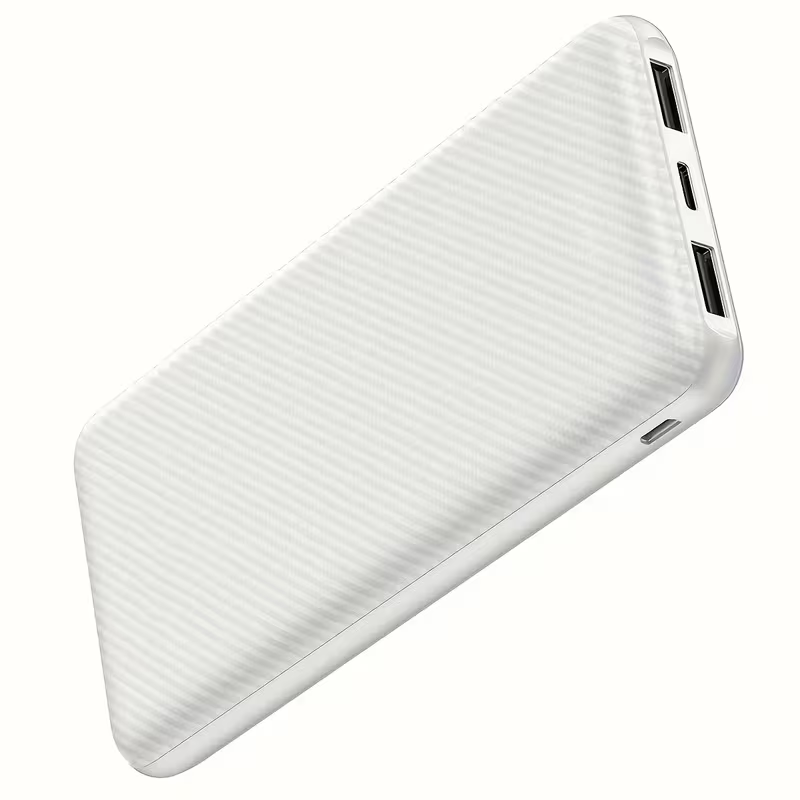
You bought a 20 000 mAh power bank. Your phone has a 5 000 mAh battery. Four full charges, surely. The box may even have promised six.
Then you used it, and got two and a half.
Nothing is broken and you have not been sold a counterfeit. The number on the box is real. It simply is not measuring what you assumed it was measuring. This is the most common complaint about power banks anywhere, and very few sellers will explain it, because the explanation makes their headline number look a lot smaller.
Here is the whole thing, with the arithmetic.
The short answer
A power bank’s rated capacity is measured inside its cells, at 3.7 volts. Your phone charges at 5 volts. Converting between the two costs energy, and the conversion circuit is not perfectly efficient either. Between those two facts, roughly a third of the rated capacity never reaches your phone.
A genuine 20 000 mAh power bank delivers somewhere around 13 000 mAh. Against a typical 5 000 mAh phone battery, that is about two and a half charges. Not four, and certainly not six.
Why mAh is the wrong unit to compare
Milliamp-hours measure electrical charge, not energy. On their own they tell you very little, because charge only becomes meaningful once you know the voltage it is held at. Comparing two batteries by mAh alone is like comparing two petrol tanks by litres without knowing whether either one is full.
The unit that actually describes stored energy is the watt-hour, and you get it by multiplying capacity by voltage:
20 000 mAh × 3.7 V = 74 Wh
That 74 Wh figure is the honest measure of what the pack holds. It is also the number airlines care about, which is why you will find it printed in small type on the casing of any power bank that takes its own compliance seriously.
Working through where the rest goes
Your phone does not charge at 3.7 volts. USB delivers 5 volts, and fast charging standards push higher still. The power bank has to step its cell voltage up to meet that, and energy is conserved, so raising the voltage lowers the available current in proportion.
Start with the 74 Wh the cells hold and deliver it at 5 volts:
74 Wh ÷ 5 V = 14 800 mAh
That is the theoretical ceiling, before anything is lost. Then reality takes its cut. The conversion circuit runs at roughly 85 to 90 percent efficiency, with the difference leaving as heat. That is why a power bank gets warm while it works.
14 800 mAh × 0.90 = 13 320 mAh
Your phone then loses a little more converting that input into stored charge in its own battery, again as heat. Call it another 5 percent. You land at roughly 12 600 to 13 300 mAh actually reaching the battery.
Against a 5 000 mAh phone, that is 2.5 to 2.7 full charges. A well-built 20 000 mAh pack should deliver around two and a half. If yours does, it is working exactly as designed.
So where does “six charges” come from?
It comes from dividing the rated capacity by the smallest phone battery the marketing department could find.
An iPhone 15 holds 3 349 mAh. Divide 20 000 by 3 349 and you get 5.97. Round it up and you have six charges on the box.
That sum ignores voltage conversion entirely, ignores every efficiency loss, and assumes you own one of the smaller batteries on the market. It is arithmetic rather than a lie, but it describes something that has never happened to anyone. The real figure for an iPhone 15 from a 20 000 mAh pack is closer to four charges, which is still good, and would have been a perfectly respectable thing to print.
What to actually expect
Working from roughly 65 percent of rated capacity reaching your device, against a typical 5 000 mAh Android phone:
- 10 000 mAh delivers about 6 500 mAh. Call it one and a quarter phone charges. A day-out power bank.
- 20 000 mAh delivers about 13 000 mAh. Two and a half phone charges, or a phone plus a comfortable tablet top-up.
- 30 000 mAh delivers about 19 500 mAh. Nearly four phone charges, or a meaningful laptop top-up if the output wattage supports it.
If you carry an iPhone, add roughly a third to those charge counts, because the battery you are filling is smaller.
The load-shedding maths is a different question
Most people size a power bank for a single outage, which is the wrong problem to solve.
Two hours away from a plug costs a phone maybe 10 to 15 percent with ordinary use. Any power bank handles that. The difficulty in South Africa is not one outage, it is three of them in a day with narrow and unpredictable windows in between, and those windows are exactly when everyone else in the house also wants to charge something.
Size for the day rather than the outage, and pay attention to a specification most listings bury: how fast the power bank recharges itself.
A 20 000 mAh pack with an 18 W input takes four to six hours to refill. The same capacity with a 65 W USB-C input does it in under two. When your mains window is ninety minutes, that difference decides whether you start the next outage full or half empty. Input wattage matters more here than it does almost anywhere else in the world, and it is routinely left off product pages.
Other things quietly costing you charge
- The cable. A cable rated below what your power bank can deliver will cap the whole chain without telling you. Anything above 60 W needs an e-marker chip in the connector to negotiate the higher current.
- Heat. Charging in a hot car or with the pack buried under a jacket wastes more energy as heat and can trigger thermal throttling.
- Age. Lithium cells lose capacity with use. Expect around 80 percent of original capacity after roughly 500 full cycles, which for most people is two to three years.
- Pass-through charging. Running a device while the power bank itself charges is convenient and noticeably less efficient. Avoid it when you have the choice.
- The last 20 percent. Charging slows sharply above 80 percent to protect the battery. If you are short on time, unplug at 80 and get on with your day.
What to look for when you buy
Now that you know where the energy goes, here is what separates a specification sheet worth trusting from one that is hoping you will not check.
- A published output capacity, not just cell capacity. A seller willing to print both numbers has nothing to hide.
- Watt-hours printed on the casing. Its absence suggests corners were cut somewhere, and you will need the figure if you ever fly with it.
- USB-C Power Delivery wattage, stated per port. Three ports sharing 18 W is a very different product from three ports sharing 65 W.
- Input wattage. How fast it refills itself, which matters more here than most places.
- Under 27 000 mAh if you fly. Airlines cap lithium cells at 100 Wh in hand luggage, and 27 000 mAh at 3.7 V is 99.9 Wh. Anything larger needs written approval from the carrier.
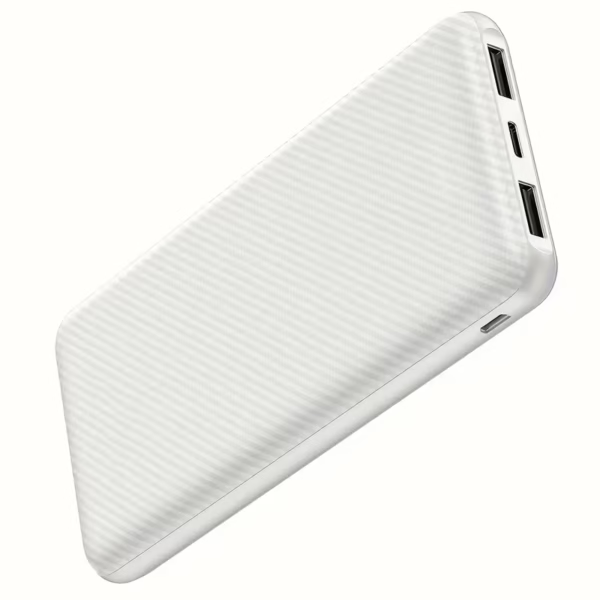
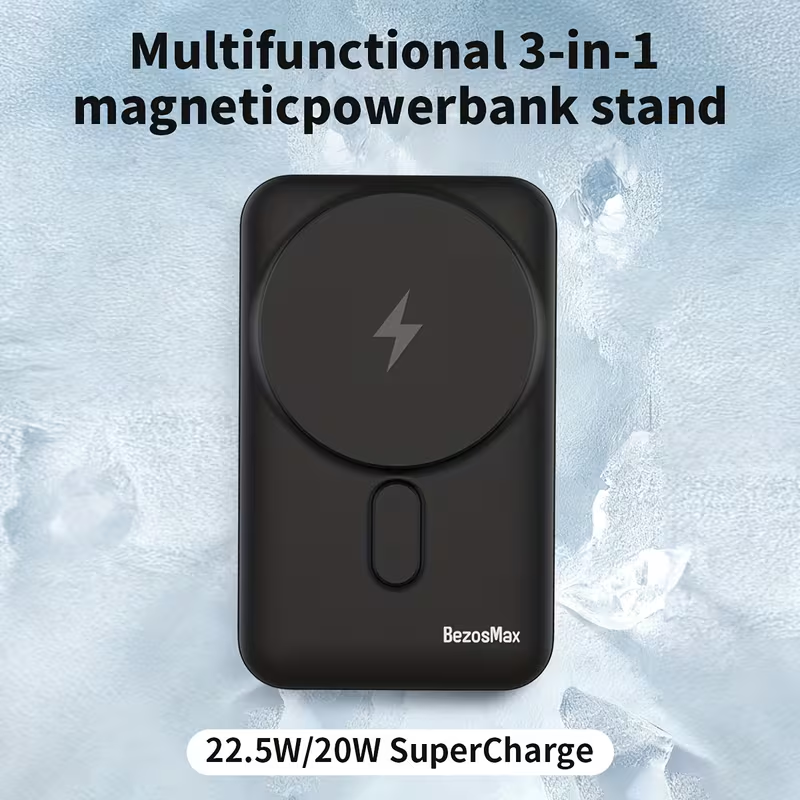
Two of ours that publish every one of those figures:
The point of all this
A 20 000 mAh power bank giving you two and a half phone charges is not a disappointment. It is physics, and every power bank on the market obeys it, including the expensive ones and the ones claiming six charges on the box.
What varies is whether the seller tells you before you buy or leaves you to discover it in an airport somewhere. We publish both figures on every power bank we stock, because a customer who knows what they are buying sends fewer things back and comes back more often.
If you are unsure which capacity suits how you actually use your phone, email us before you order. We would rather talk you into a smaller one that fits than process a return.